New research shows how AI is changing productivity. Against slower Philippine economic growth, elevated inflation, and uneven business demand, the harder question is how those gains translate into operating performance.
Imagine a business reviewing two reports at month-end.
The first shows encouraging progress in artificial intelligence adoption. Employees are using AI more frequently. Customer inquiries are being answered faster. Reports that previously took several hours to prepare can now be done in minutes. Staff members are producing more quotations, presentations, and analyses.
The second report presents a more difficult picture. Customer orders have weakened. Operating expenses have increased. Inventory is moving more slowly, and management is becoming careful about additional spending.
Both reports can be accurate.
The company may be improving how efficiently certain tasks are performed while experiencing weaker business conditions. The distinction becomes important when management begins assessing whether its investment in AI is paying off.
Should success be measured by hours saved, the number of tasks completed, reduced operating expenses, improved customer service, or stronger financial performance? What happens when productivity improves but revenue declines because customers are buying less?
These questions have become more relevant as I examine developments from our weekly digital economy and economic briefings. Technology research increasingly documents gains from AI-assisted work, while Philippine economic indicators show businesses navigating an environment where demand, costs, and performance differ across sectors.
Bringing these two sets of information together reveals a challenge that deserves closer examination: how do we separate the benefits of AI from the wider economic conditions influencing business results?
What recent AI research actually tells us
In October 2026, Atlassian released its State of Developer Experience Report 2026, based on a survey of more than 1,500 software practitioners.
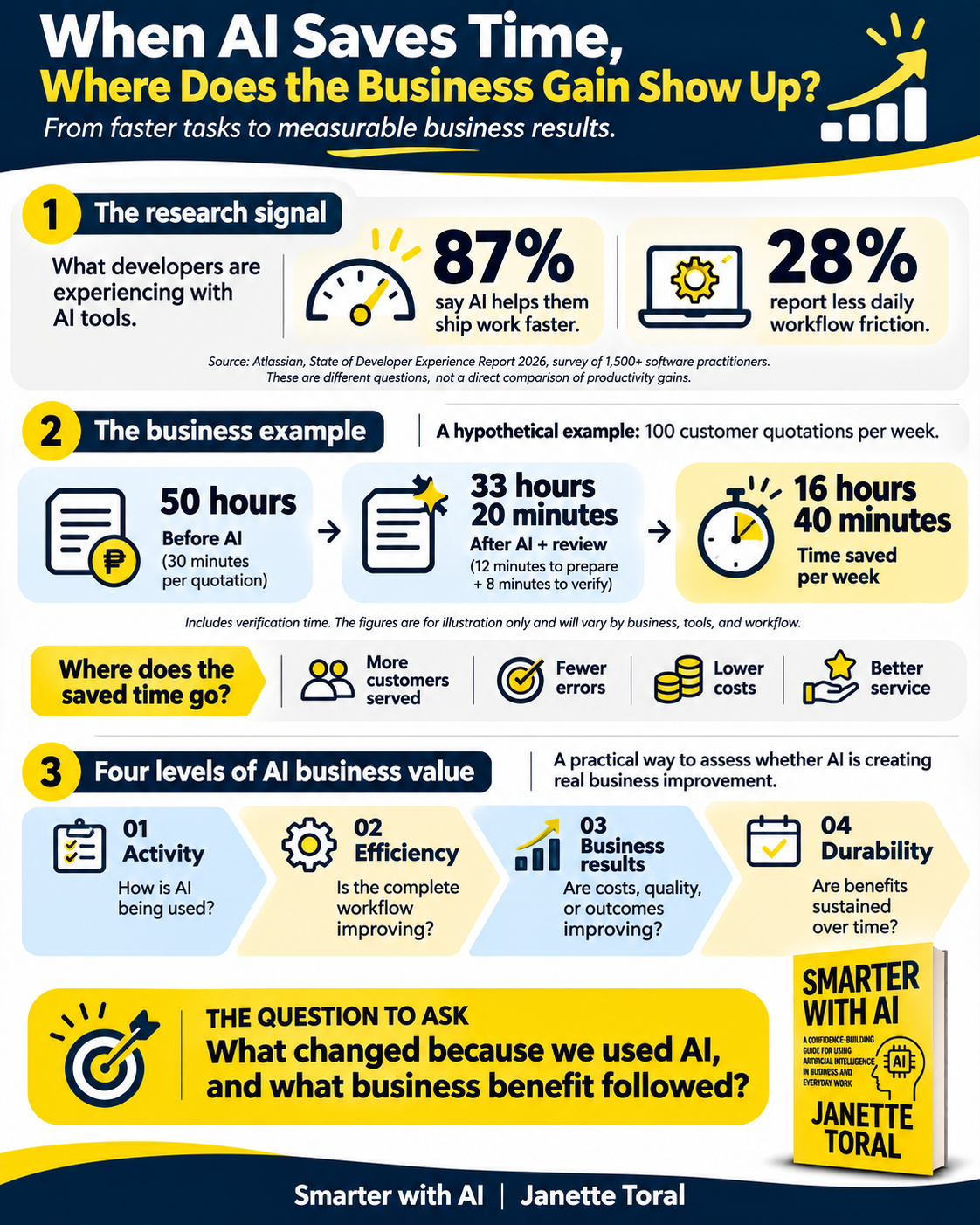
The report found that 87% of developers said AI helped them ship work faster. At the same time, only 28% reported noticeably less friction in their daily workflows.
Another finding was that 49% spent at least four hours each week reviewing AI output, correcting prompts, and performing related work.
Perhaps more revealing was the difference between expectations and actual practices. Some 64% of engineering leaders associated greater AI usage with better outcomes, while 41% of developers said they sometimes used AI more than necessary because they felt expected to do so.
These figures describe the perceptions and experiences of the surveyed software practitioners. They do not directly measure productivity across Philippine businesses or establish how much financial value AI creates.
They nevertheless raise a useful management question.
If employees complete their individual assignments faster but continue spending time waiting for approvals, correcting information, coordinating with colleagues, or resolving customer problems, how much of the improvement reaches the organization?
A company could generate reports more quickly while its decision-making process remains unchanged. A customer service team might draft responses in seconds but still depend on another department to resolve the underlying issue.
The benefits may be real, although their effects on the complete workflow require separate measurement.
Even controlled productivity research has produced results that call for careful interpretation.
A 2025 study by Model Evaluation & Threat Research found that experienced open-source developers took approximately 19% longer to complete certain tasks when using the AI tools available during the study period.
In February 2026, the researchers published an update explaining that newer tools were likely producing greater speed improvements, but changes in participant behavior and research conditions made the newer estimates difficult to interpret reliably.
The studies examine different circumstances and should be read within their methodological limits.
Their combined contribution is straightforward: the effect of AI depends on the task, the capabilities of the user, the surrounding workflow, and the way performance is measured.
For businesses, productivity claims become more useful when accompanied by evidence showing what changed, what remained the same, and how the improvement affected operations.
The Philippine economy adds another dimension
The economic conditions facing Philippine businesses make this distinction especially relevant.
On November 9, the Philippine Statistics Authority reported that gross domestic product grew by 2.1% year on year in the third quarter of 2026. Household final consumption expenditure increased by 2.4%, while gross capital formation declined by 0.2%. The figures describe an economy experiencing modest growth, with different sources of demand contributing unevenly.
Inflation adds pressure to household and business decisions. According to the PSA’s October 2026 inflation report, headline inflation reached 7.8%, up from 7.2% in September. Transport, housing and utilities, and food costs were among the major contributors.
Higher prices can alter purchasing behavior even when consumers continue spending. Households may prioritize essential expenses, adjust quantities, postpone purchases, or switch to lower-priced alternatives.
For businesses, the challenge is twofold. They must respond to changing demand while managing the effects of higher costs on their own operations.
The Purchasing Managers’ Index (PMI) Philippines offers another perspective. Through the research collaboration of the Philippine Institute for Supply Management, the Foundation of the Society of Fellows in Supply Management, and i-Metrics Asia-Pacific Corporation, we monitor changes in business conditions across Manufacturing, Retail-Wholesale, and Services.
In September 2026, Manufacturing registered a PMI of 51.5, indicating a return to expansion. Retail-Wholesale recorded 46.8, while Services posted 48.5. Both remained below the 50-point threshold.
These indices measure the direction and breadth of changes reported by participating companies compared with the preceding month. They are different from national accounts, which measure economic output. PMI readings also provide no direct evidence of whether companies are using AI.
What they reveal is an operating environment in which businesses may face different conditions even within the same economy.
A manufacturer receiving stronger orders might focus on improving production scheduling and delivery performance. A retailer facing subdued customer purchases could prioritize inventory movement and conversion. A service provider experiencing elevated costs may look for ways to reduce rework and maintain service quality.
An AI initiative could help each business, but the definition of improvement would differ. This is why the economic context should influence how managers interpret technology-related gains.
When demand weakens, faster processing may help a company preserve capacity or control expenses. When demand strengthens, the same capability might allow the business to handle more orders without immediately expanding its workforce.
The technology has produced a similar operational change, but the economic benefits are expressed differently.
A simple example: the difference between time saved and value created
Consider a distributor that prepares 100 customer quotations each week. Before introducing an AI-assisted workflow, its employees spend an average of 30 minutes preparing and checking each quotation.
Suppose the business introduces a tool that reduces preparation time to 12 minutes, followed by another eight minutes of employee verification. The complete process now requires 20 minutes per quotation.
For 100 quotations, the business saves approximately 16 hours and 40 minutes of work each week. This is a hypothetical illustration rather than a measured result from an actual company.
It demonstrates a distinction worth making. If management looks only at the initial preparation stage, it may describe a much larger efficiency gain than the improvement observed across the complete workflow.
The additional verification time is part of the process and should be included. The next question concerns what happens to the time saved.
If the employees use those hours to respond to more customer inquiries, the business may increase its service capacity. If they use the time to follow up on pending quotations, management can examine whether conversion rates improve. If the improvement reduces overtime, the savings may be directly visible in expenses.
The business might also experience fewer rushed quotations and better staff workloads. These benefits are worth evaluating, although each requires its own evidence.
Suppose customer inquiries decline during the following month because market demand has weakened. The company may prepare fewer quotations overall despite its faster workflow. That would make a simple comparison of monthly quotation volumes misleading.
To evaluate the change fairly, management could track preparation time per comparable quotation, correction rates, customer response times, employee hours, and the proportion of quotations converted into actual orders. It could then assess whether the results differ from similar periods before the tool was introduced, accounting where possible for changes in demand, pricing, product mix, and staffing.
The financial assessment also needs to include the cost of the AI subscription, implementation, training, and employee review time.
Time saved does not automatically become cash savings. A company paying the same salaries may gain additional capacity rather than an immediate reduction in expenses. That capacity can still be valuable. Its contribution becomes clearer when managers establish how the released time is used and what operational benefit follows.
Different sectors need different productivity measures
A universal measure of AI success would overlook important differences among industries.
For a manufacturing company, productivity might involve the quantity of acceptable products completed per production hour, the frequency of defects, equipment downtime, or the accuracy of material requirements.
If AI-assisted planning helps reduce unnecessary production adjustments, management could evaluate the resulting changes in output, waste, and production costs. But higher output alone may create additional inventory if customer orders remain weak. The business therefore needs to understand whether improved production efficiency is aligned with actual demand.
For retailers and wholesalers, AI might help with customer inquiries, stock analysis, replenishment recommendations, or product information. Relevant measures could include the proportion of inquiries converted into sales, stockout frequency, inventory turnover, order fulfillment accuracy, and gross contribution after discounts and returns.
An AI system that increases the number of promotional messages without improving customer conversion may have expanded marketing activity while leaving the commercial outcome largely unchanged. Conversely, a better replenishment process could reduce stockouts or excess inventory, delivering value even during a period of restrained sales.
Service companies face another set of considerations. An AI-assisted customer service workflow could reduce average handling time. Management would also need to examine whether customers receive accurate answers, whether issues are resolved during the initial interaction, and how frequently cases must be reopened.
For professional services, AI might reduce time spent preparing preliminary analyses or documentation. The resulting capacity could allow professionals to handle additional assignments, provide more attention to clients, or undertake more complex work.
Measures of employee workload, quality, and customer experience become useful safeguards. A productivity initiative that appears successful because tasks are completed faster may be less attractive if errors increase or employees spend additional time repairing problems.
The underlying principle is to identify the economic result appropriate to the activity being improved. This also requires distinguishing improvements that are directly attributable to an intervention from changes influenced by external conditions.
Higher sales could reflect stronger market demand, seasonal purchasing, price adjustments, or the efforts of a sales team. An AI-supported workflow may contribute, but its specific effect needs to be examined.
Philippine companies are building capabilities faster than outcomes
A timely Philippine study provides further evidence for this discussion. On November 11, Boston Consulting Group and Makati Business Club released The Philippine AI Maturity Report. The research covered 35 large Philippine companies across 12 industries and assessed their AI maturity against a global framework.
It found that 60% of the participating companies were in the Stagnating or Emerging stages, while none had reached the highest category, described as Future-built. The distinction between capabilities and results is particularly relevant.
Across the report’s maturity assessment, AI-enabling capabilities covering technology, data, people, and operating models received an average score of 46. Business outcome areas covering innovation, customer experience, and operations averaged 37. These are maturity assessment scores rather than percentages of realized financial returns.
The findings suggest that the surveyed companies have made more progress developing the foundations for AI than translating those capabilities into business outcomes. The study also reported that 54% of the participating companies aspire to reach Future-built maturity by 2029. Ambition can encourage investment, but the extent of progress will be clearer when organizations begin demonstrating results across the business activities they intend to improve.
The research has important boundaries. Its respondents were large companies, so the findings should be interpreted as insights into that participating group rather than a direct description of all Philippine MSMEs. Nevertheless, the report introduces a useful distinction for business leaders.
An enterprise can invest in infrastructure, acquire licenses, provide training, and launch projects. Those activities build organizational capacity. A separate assessment is needed to determine whether the investments are improving customer experiences, reducing operating costs, supporting innovation, or strengthening financial performance.
This becomes especially important in a period when businesses are allocating limited resources among technology, employee development, inventory, and other operating requirements.
What would a credible AI business performance assessment look like?
I believe organizations would benefit from treating AI initiatives as measurable operating changes rather than evaluating them primarily through usage statistics. A practical assessment could begin with a specific activity and establish how it performs before any changes are introduced.
For a customer service process, this might involve recording average handling time, resolution rates, correction requirements, customer satisfaction, and the number of cases completed per employee hour.
For purchasing, the organization could examine the time required to evaluate supplier quotations, purchasing accuracy, delivery performance, and exceptions requiring manual intervention.
For sales operations, it might review inquiry response times, quotation completion, conversion, and contribution margins.
The next step is to measure the same activities after introducing AI, including the additional work involved in reviewing and correcting its outputs. A comparison over several weeks or months is more informative than a demonstration conducted under ideal conditions.
Where practical, organizations can compare similar tasks handled with and without the new workflow. They should record changes in customer volumes, staffing, product mix, and other conditions that may affect the results.
Perfect isolation of every influence may be difficult, particularly for smaller businesses. A transparent assessment that identifies its limitations is still preferable to assuming every improvement came from AI.
I would examine the evidence at four levels.
The first concerns activity: how frequently the tool is used and which tasks it supports.
The second concerns operational performance: how much time, effort, rework, and cost are involved in completing the process.
The third concerns business results: whether the improvement contributes to service quality, customer conversion, fulfilled orders, reduced waste, or better margins.
The fourth concerns durability: whether the gains continue as workloads change, employees rotate, systems are updated, and the organization encounters unexpected conditions.
These are proposed areas for practical measurement, rather than a formal industry standard.
An initiative may perform well at one level while showing limited progress at another. Those differences are useful because they help managers understand where further adjustments are required.
A related lesson can be drawn from the way economic indicators are reported. On November 12, the PSA announced that approved foreign investments reached ₱166.03 billion in the third quarter, a 125.3% increase from the same period in 2025.
The agency also reported projected employment of 27,799 jobs from approved investments by both Filipino and foreign nationals, slightly below the comparable year-earlier figure.
These are different measures, describing investment approvals and projected employment rather than realized production, spending, or actual hiring. They are valuable indicators when interpreted according to what they measure.
The same discipline is useful when evaluating AI. A budget allocation describes resources committed. An active user count describes participation. Neither, by itself, establishes the resulting economic benefit.
What should organizations and policymakers pay attention to?
The timing of these findings is significant. ASEAN leaders adopted the ASEAN Leaders’ Declaration on AI-Powered MSME Growth on November 15, 2026, recognizing the need to strengthen AI access, skills, digital infrastructure, and appropriate safeguards among smaller enterprises.
The Philippines also established a national AI governance framework and the National Artificial Intelligence Council through Executive Order No. 131, signed on November 12. These initiatives provide an opportunity to examine how AI capability-building can translate into economic benefits over time.
For programs supporting MSMEs, registration and attendance figures are useful indicators of reach. The next level of evaluation could examine whether participants apply the training, improve a recurring process, and sustain those improvements.
A program that trains hundreds of entrepreneurs may create substantial value, particularly when it expands access to capabilities they previously lacked. To understand the economic effects, organizers could follow up on selected business outcomes after implementation.
For workforce initiatives, demonstrating proficiency in AI tools is an important foundation. Evaluations could also consider whether participants complete relevant tasks accurately, reduce avoidable rework, and maintain service quality.
Organizations should recognize differences in resources and capabilities when designing these assessments. A microenterprise may rely on simple records and a limited set of indicators, while a large company can use more detailed financial and operational analysis.
The objective is evidence appropriate to the scale and purpose of the intervention. This perspective also helps explain why AI training, access, and experimentation remain worthwhile even when immediate financial returns are uncertain.
Some benefits involve developing capabilities that an organization may use later. Others support innovation, employee learning, or improved resilience. The important distinction is between benefits already observed and benefits expected to emerge. Both can inform investment decisions, provided they are clearly identified.
Looking beyond adoption as the economy changes
The combination of recent technology research and Philippine economic indicators creates a more demanding test for AI investments.
AI-assisted tools may help employees complete tasks faster, handle information more effectively, and expand the range of activities an organization can perform. Meanwhile, customer demand, inflation, competition, and sector conditions continue to influence business performance.
A company could achieve a genuine productivity improvement while experiencing declining sales. Another might report strong revenue growth despite receiving limited benefits from its AI investments. These outcomes need to be understood separately before concluding the technology’s contribution.
For managers, the next step is to connect specific AI applications with clearly defined operational and financial indicators.
For workers, the opportunity includes developing capabilities that improve the quality, capacity, and effectiveness of their work.
For institutions supporting digital transformation, the challenge is to make the relationship between capability-building and observed outcomes more visible.
Through our digital economy and economic briefings, I am increasingly interested in examining these connections. Technology adoption trends show which capabilities are becoming available. Economic indicators help explain the conditions businesses are navigating. Company-level evidence is needed to establish where those capabilities are producing results.
As AI becomes part of everyday business operations, its contribution will be reflected in more than the number of people using it or the quantity of work they generate. Sometimes the gain will appear in higher output or stronger sales. In other situations, it may take the form of lower costs, fewer errors, improved service, reduced waste, or the ability to preserve operating capacity during difficult conditions.
The useful question for business leaders is becoming more specific: What changed because we used AI, how much of that change can we verify, and what economic benefit followed?
Answering that question can turn AI productivity from an encouraging claim into evidence that supports better business decisions.

Leave a Reply