Can Fairer Commercial Relationships Build Stronger Philippine Businesses?
Introducing the Supplier Fair Dealing Framework Version 1.0: A public invitation to improve commercial transparency, accountability, and sustainability.
[Download the Supplier Fair Dealing Framework Version 1.0]
[Participate in the Stakeholder Consultation]
Every business depends on relationships with other businesses. Manufacturers depend on distributors and retailers to bring their products to market. Retailers depend on suppliers to maintain product availability and quality. Digital marketplaces connect merchants with customers while managing transactions, logistics, payments, and platform risks.
These relationships create growth opportunities. They also involve commercial decisions that can significantly affect the businesses participating in them.
How are listing fees explained and accounted for? What happens when a supplier disputes a deduction? How should marketplace operators communicate changes in fees? What safeguards should apply when a merchant account is suspended or proceeds are withheld? How can businesses address concerns without undermining legitimate commercial decisions or exposing themselves to retaliation?
These questions deserve attention because the quality of commercial relationships affects more than individual transactions. It can influence working capital, inventory availability, administrative costs, business continuity, and the willingness of enterprises to invest in new markets.
The time to examine these practices is before avoidable disputes and operational weaknesses become more difficult and costly to resolve.
Introducing the Supplier Fair Dealing Framework
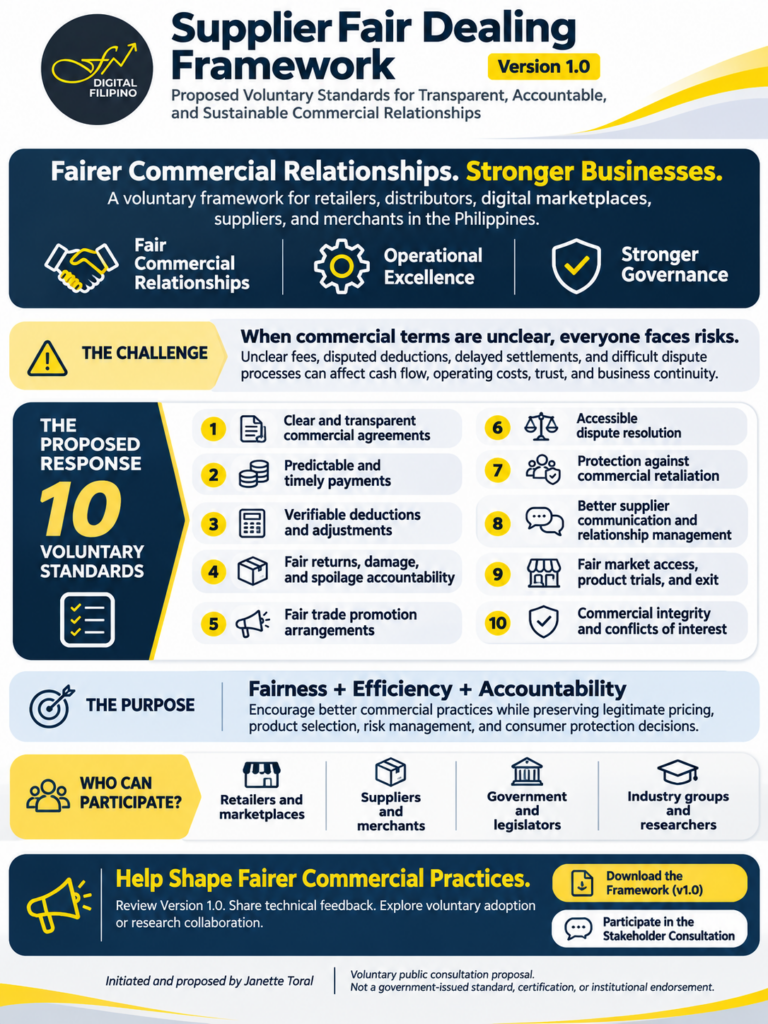
The Supplier Fair Dealing Framework Version 1.0 is an independently initiated advocacy proposal by Janette Toral, presented for public stakeholder consultation.
It proposes voluntary standards for transparent, accountable, and sustainable commercial relationships among retailers, distributors, digital marketplaces, suppliers, and merchants in the Philippines.
The framework is guided by three connected objectives:
1. Fair Commercial Relationships. Encourage understandable agreements, verifiable charges, predictable processes, accessible dispute resolution, and reciprocal accountability.
2. Operational Excellence. Reduce avoidable reconciliation work, processing delays, disputes, and inefficiencies that can affect both buyers and suppliers.
3. Stronger Governance. Support responsible commercial decisions through documented policies, internal controls, appropriate oversight, and effective remedies.
The framework does not assume that suppliers are always right or that buyers and marketplaces are inherently unfair. Retailers and platform operators must be able to manage profitability, product selection, fraud, consumer protection, operational capacity, and commercial risks. Suppliers and merchants must likewise meet their obligations concerning quality, fulfillment, documentation, and ethical conduct.
The objective is to encourage commercial arrangements in which legitimate business discretion is exercised with transparency and accountability.
Why this discussion is urgent
Digital commerce has expanded the ways businesses reach customers, but it has also introduced additional layers of commercial fees, platform rules, transaction processing, and account enforcement.
Traditional distribution and retail arrangements have their own complexities. Listing requirements, promotional contributions, product trials, returns, deductions, and payment reconciliation can affect the financial and operational capacity of participating suppliers.
For smaller enterprises, uncertainty over costs, payment timing, or access to transaction records may be particularly difficult to absorb. For retailers and marketplaces, poorly designed controls can create administrative burdens, fraud exposure, and operational inefficiencies.
These are issues worth examining systematically. They should not be treated as proof that particular practices are widespread, unlawful, or inherently unfair. Different commercial arrangements may have legitimate purposes, and their effects need to be assessed in context.
What is increasingly important is having a common reference for asking whether commercial terms are understandable, processes are accountable, and remedies are proportionate.
Waiting for disputes to accumulate before examining these practices may mean missing opportunities to improve the systems that businesses already use every day.
Ten proposed standards for fair commercial dealing
Version 1.0 presents ten standards for voluntary consideration.
1. Transparent Commercial Agreements. Commercial terms, charges, service commitments, and material changes should be understandable before businesses make significant commitments. This includes consideration of cumulative costs across products, branches, channels, and mandatory services.
2. Predictable and Timely Payments. Verified and undisputed amounts should be processed according to applicable commitments. Payment holds, reserves, and settlement restrictions should have a documented basis, appropriate review, and clear reconciliation procedures.
3. Verifiable Deductions and Adjustments. Charges, penalties, credits, and deductions should be supported by records that affected parties can reasonably examine and question.
4. Fair Returns, Damage, and Spoilage Accountability. Responsibility for product losses should be assessed using evidence, agreed obligations, and the circumstances that contributed to the loss.
5. Fair Trade Promotion Arrangements. Promotional contributions should be linked to understandable commitments and verifiable execution, with proportionate remedies when agreed services are not delivered.
6. Accessible Dispute Resolution. Businesses should have practical channels for raising concerns, receiving reasoned decisions, and seeking appropriate review without unnecessary cost or complexity.
7. Protection Against Commercial Retaliation. Good-faith complaints should not become grounds for improper punishment. Legitimate decisions involving safety, fraud, quality, or performance must remain possible and appropriately documented.
8. Supplier Communication and Relationship Management. Material commercial changes should be communicated clearly, with reasonable opportunities for clarification, preparation, and transition.
9. Fair Market Access, Product Trials, and Exit. Listing arrangements, product trials, account restrictions, delisting, and termination should be administered through understandable and accountable processes. This does not guarantee listing, sales, continued access, or profitability.
10. Commercial Integrity and Conflicts of Interest. Organizations should maintain safeguards against improper demands, undisclosed personal benefits, conflicts of interest, and misuse of commercial authority.
These standards are intended to be applied proportionately. A small retailer should not be expected to maintain the same administrative systems as a national retail chain or large digital marketplace.
Why businesses should consider voluntary adoption
The framework is not intended to create another layer of paperwork without corresponding value.
Businesses considering adoption should examine whether selected practices can improve their operations. Better documentation may reduce reconciliation time. Clearer dispute procedures may prevent repeated escalation. More consistent commercial decisions may strengthen internal controls and partner relationships.
These are potential benefits to be tested, not guaranteed outcomes.
Version 1.0 therefore encourages organizations to begin with practical assessments and targeted pilots. A business may review existing procedures, identify two or three areas for improvement, establish baseline measures, and evaluate whether changes deliver benefits without creating disproportionate costs or weakening necessary risk controls.
Participation in consultation is not adoption. Partial adoption should be described accurately, and no certification, accreditation, or independent fairness rating is created by this framework.
The connection to corporate governance and sustainability
Fair commercial dealing is also relevant to how organizations govern their relationships with external business partners.
Boards and management teams may need visibility into recurring disputes, unresolved deductions, commercial integrity concerns, payment-processing risks, and the effectiveness of corrective actions.
Some practices may also inform environmental, social, and governance (ESG) assessments. For example, responsible commercial relationships may be relevant to social and economic impacts on smaller enterprises, while transparent decision-making and conflict-of-interest controls are governance considerations.
Support environmental relevance with evidence, such as reductions in preventable spoilage or waste.
Adopting the framework does not automatically establish ESG compliance, conformity with sustainability reporting standards, or independent assurance. Its proposed indicators are intended to support better management and evidence-based assessment.
An invitation to industry, government, legislators, and researchers
The Supplier Fair Dealing Framework is being made publicly available because its usefulness depends on scrutiny from different perspectives.
Retailers, distributors, and digital marketplaces are invited to review the proposed standards, identify operational challenges, and consider whether selected practices can be piloted or voluntarily adopted.
Suppliers, manufacturers, merchants, and industry associations are encouraged to examine whether the framework addresses practical commercial concerns while recognizing their own responsibilities and the legitimate needs of buyers.
Government agencies and regulatory bodies are invited to consider whether existing rules, administrative guidance, enforcement mechanisms, or industry engagement can adequately address documented concerns.
Legislators and legislative research offices are encouraged to examine the evidence, conduct consultations and comparative studies, and assess whether policy or legislative changes may be justified.
Academic institutions, researchers, governance professionals, and other interested parties are welcome to contribute independent analysis, implementation perspectives, and technical recommendations.
The framework recognizes a possible long-term development pathway from voluntary standards and evidence-building to institutional adoption, regulatory or administrative improvements, and legislative reform where justified.
It does not presume that every concern requires new regulation or legislation.
Help shape the next version
Version 1.0 is a public consultation draft, not a finalized industry standard.
Stakeholder feedback is particularly important in identifying provisions that are useful, unclear, difficult to implement, potentially burdensome, or in need of additional safeguards.
Interested parties are invited to:
- Download and review the complete Supplier Fair Dealing Framework Version 1.0.
- Submit technical comments, alternative proposals, and implementation concerns through the stakeholder consultation form.
- Express interest in voluntary pilot initiatives, research collaboration, or policy dialogue.
Respondents may participate in their personal or professional capacity. Providing comments does not imply endorsement, organizational adoption, or agreement with every provision.
The consultation is intended to gather constructive feedback, not confidential complaints or allegations against particular businesses.
[Download the Supplier Fair Dealing Framework Version 1.0]
[Participate in the Stakeholder Consultation]
Building stronger commercial relationships together
A sustainable commercial ecosystem requires more than businesses competing for customers. It also depends on the quality of the relationships through which products, services, payments, information, and opportunities move.
Fairness should not be understood as removing commercial risk or guaranteeing favorable outcomes. It should involve understandable commitments, reciprocal responsibilities, accountable decisions, and reasonable opportunities to resolve problems.
The Supplier Fair Dealing Framework offers a starting point for examining these practices together.
The invitation is not simply to support a document. It is to help determine which commercial practices can make Philippine businesses more transparent, efficient, accountable, and sustainable.
The earlier these conversations begin, the greater the opportunity to improve practices before problems become entrenched.
About the initiative: The Supplier Fair Dealing Framework is independently initiated and proposed by Janette Toral. Version 1.0, dated November 14, 2026, is released for public stakeholder consultation. It is not a government-issued standard, a certification scheme, an institutional endorsement, or a finding of wrongdoing against any organization. The proposal remains subject to stakeholder feedback, independent evidence, and applicable legal review.
Earlier writings related to this topic
- Are we making our suppliers stronger or weaker?
- Why more online sales don’t always mean more profit
- Does the Philippines need a Supplier Fair Dealing Framework?
- What should fair treatment of suppliers look like?
- Why Philippine retail now requires systems thinking
- Beyond Inflation: The Real Reason Your Favorite Local Brands Disappear
- When payment and placement become uncertain in modern retail
- From retail shelf space to screen space
- When access to retail shelves becomes a competition issue
- Why local products quietly disappear from supermarkets
- Why products are expensive, and it is not just inflation

Leave a Reply