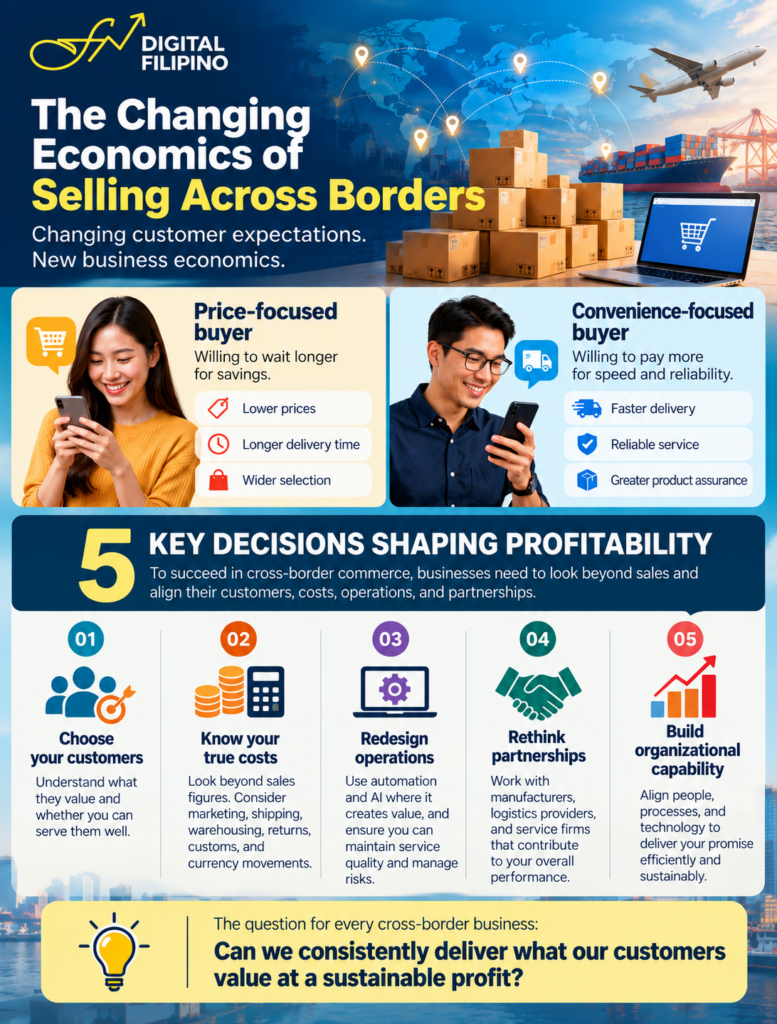
A customer is willing to wait two weeks for a cheaper product. Another is prepared to pay more to receive the same item within two days. Both are making reasonable decisions based on their priorities, but these choices create different challenges for businesses selling across borders.
The first customer may be attracted by lower prices and willing to accept longer delivery times. The second may value convenience, reliability, and immediate availability more. For sellers, deciding which customers to serve influences pricing, inventory, logistics, marketing, and customer service.
Meanwhile, businesses themselves are reconsidering how they operate. Automation is changing staffing requirements, digital platforms are reshaping competition, and service providers face growing expectations to demonstrate their contribution to business performance.
These developments raise a question that extends beyond international e-commerce: How can businesses remain profitable when customer expectations and the cost of serving them are changing?
Understanding what customers value
Cross-border e-commerce has made international products more accessible. Consumers can compare offerings from sellers in different countries, often without knowing where a product was manufactured or where the business is based.
However, greater access also gives customers more choices. Economic uncertainty, household expenses, and concerns about future income can influence how people evaluate purchases. Some consumers become more price-sensitive, while others remain willing to pay for quality, convenience, product authenticity, or dependable service.
The growing visibility of low-price platforms such as Temu illustrates how international competition is challenging established pricing and fulfillment approaches. Consumers may accept longer delivery periods when the savings are attractive enough. Others prefer sellers offering faster shipping, easier returns, or greater confidence in product quality.
Research from DHL’s 2026 global e-commerce survey suggests that lower prices are an important motivation for international purchases, while delivery costs and transit times remain concerns for shoppers.
The implication is that businesses cannot assume all customers value the same things. Competing primarily on price may attract one segment but expose a seller to intense competition and narrow margins. Offering faster fulfillment or better service may justify higher prices, provided customers recognize and are willing to pay for those benefits.
Successful positioning begins with understanding the customers a business can serve well rather than attempting to satisfy everyone.
When growing sales become less profitable
Digital marketplaces have lowered many barriers to international selling. Smaller businesses can reach overseas customers without establishing physical stores in every destination market. Technology also makes it easier to manage advertising, orders, payments, and customer communication.
Yet reaching more customers introduces costs that may be less visible when businesses focus mainly on sales figures.
Marketplace commissions, advertising expenses, shipping charges, warehousing, returns, customs requirements, and currency fluctuations all influence profitability. A seller may experience increasing revenue while retaining less income from each transaction.
Consider a business that lowers prices to compete with international sellers. Sales volume may improve, but additional advertising expenditure and fulfillment costs could consume much of the remaining margin. Alternatively, offering faster delivery may require maintaining inventory closer to customers, creating additional warehousing and financing requirements.
The business must therefore evaluate whether its competitive promise can be delivered at a sustainable cost.
Cash flow adds another complication. Sellers may pay manufacturers and logistics providers long before receiving proceeds from customer purchases. When inventory moves slowly or demand changes unexpectedly, even a growing business can encounter financial pressure.
These conditions make profitability, inventory management, and cash flow just as important as customer acquisition and sales growth.
Automation changes the cost of doing business
Businesses are also examining whether technology can help them deliver products and services more efficiently.
Activities such as order processing, inventory updates, routine customer inquiries, administrative reporting, and internal coordination can increasingly be supported by automation and artificial intelligence.
Through my work in leadership development, coaching, and organizational processes, I have observed how technology can substantially change the responsibilities assigned to employees. Work previously distributed among several people may eventually be handled by a smaller team using integrated systems.
For some businesses, automation creates opportunities to reduce operating expenses. Others use it to accommodate higher transaction volumes, improve accuracy, or allow employees to focus on customers and more complex responsibilities.
However, the benefits depend on how the changes are implemented. A smaller team may become more productive, but it can also become vulnerable when employees carry too many responsibilities or automated processes encounter problems.
Businesses must consider what happens to displaced workers, which skills remaining employees need, and how service quality and accountability will be maintained.
The objective should be stronger organizational performance rather than simply reducing the number of people involved.
Service providers must rethink their contribution
Changes within sellers’ organizations also affect the companies supporting them.
A marketing agency may find that clients increasingly expect evidence of profitable customer acquisition rather than campaign activity alone. A logistics provider may need to offer different combinations of delivery speed, cost, and reliability. A sourcing specialist may create greater value by helping businesses manage supplier risks and improve production flexibility.
Technology providers, consultants, and other professional service firms face similar questions as clients automate routine activities or bring certain functions in-house.
This does not necessarily mean businesses will stop using external expertise. Their requirements may become more specialized.
A company operating across several countries may need assistance with regulatory requirements, systems integration, supplier coordination, market intelligence, or organizational development. As operations become more technologically advanced, the ability to solve complex problems and support sound decisions can become a stronger source of competitive advantage.
For service providers, the opportunity lies in understanding how their work contributes to the client’s overall performance.
Building a business that can keep its promise
Technology, lower prices, and international market access can create opportunities, but none guarantees a sustainable business.
A seller promising affordability must manage costs carefully. A business competing on convenience needs reliable inventory and fulfillment arrangements. A company emphasizing quality must maintain standards across suppliers and markets.
Each approach requires a different combination of people, processes, technology, and partnerships.
Leadership also becomes important when businesses must reconsider familiar practices. Managers need to decide which activities to automate, where employees can contribute greater value, and when external partners can provide capabilities that would be difficult to develop internally.
 These are among the questions I hope to explore during my upcoming participation in the Cross Border Summit in Chiang Mai, Thailand. The gathering brings together international marketplace sellers, manufacturers, service providers, and other professionals involved in cross-border commerce.
I am particularly interested in learning how these businesses are responding to changing consumer preferences, managing profitability pressures, and redesigning operations as technology advances.
International expansion may begin with gaining access to customers in other countries. Sustaining that growth requires a clearer understanding of which customers to serve, what they are willing to pay for, and the resources needed to meet their expectations.
The customer willing to wait two weeks for a lower price and the customer paying more for faster delivery are both presenting business opportunities. The challenge is choosing which promise a company can consistently fulfill while earning a reasonable return.
That may be the more useful measure of success in cross-border commerce: the ability to create value for customers while building a business capable of sustaining it.
Join the DigitalFilipino Viber Channel for articles, insights, and occasional updates.

Leave a Reply