Business conditions are rarely as straightforward as a single economic indicator suggests. A company may see slower customer orders while still facing higher operating costs. Another may increase hiring even when overall business activity remains subdued. These differences matter because industries, organizations, and markets do not necessarily move in the same direction.
The August 2026 Purchasing Managers’ Index (PMI) Philippines results provide an opportunity to examine these differences. The monthly research, undertaken through the collaboration of the Foundation of Society of Fellows in Supply Management (SOFSM), the Philippine Institute for Supply Management (PISM) and i-Metrics Asia-Pacific Corporation, tracks business conditions across Manufacturing, Retail-Wholesale and Services.
What makes the findings useful is not simply whether an index increases or decreases. It is the opportunity to understand how businesses are experiencing changes in demand, orders, production, inventories, employment, costs and supplier conditions.
Improvement does not always mean expansion
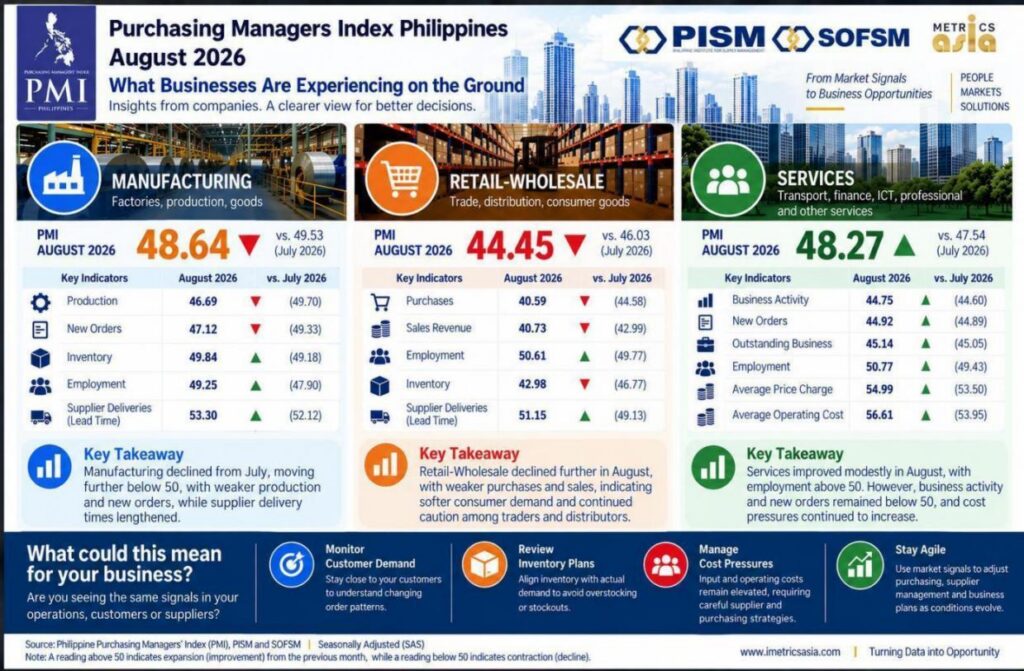
One of the more interesting developments in August came from the Services sector. Its overall PMI increased from 47.54 in July to 48.27 in August. At first glance, the movement suggests improving business conditions. However, the index remained below the 50-point threshold, indicating that the sector continued to experience contraction, although at a slower pace.
Looking beneath the overall index provides a more detailed picture. The Business Activity Index increased slightly from 44.60 to 44.75, while New Orders moved from 44.89 to 44.92. Both remained below 50, indicating that activity and orders were still weakening compared with the previous month.
Employment presented a different signal, increasing from 49.43 to 50.77 and moving into expansion territory. Meanwhile, the Operating Costs Index rose from 53.95 to 56.61, suggesting more widespread increases in operating costs.
These movements illustrate why economic data requires careful interpretation. An improving headline does not necessarily mean that demand has recovered. Likewise, an increase in employment does not automatically establish that businesses expect stronger sales. Understanding the reasons behind these movements requires additional evidence.
For business leaders, the more useful question is not simply whether conditions improved, but which aspects of their operating environment are changing and how those changes affect their decisions.
Different sectors, different business realities
The August findings also reinforce the importance of examining Manufacturing, Retail-Wholesale and Services separately. These sectors operate under different conditions, serve different markets and respond differently to changes in demand, costs and supply arrangements.
Manufacturers may be concerned about production schedules, purchasing requirements, inventories and supplier delivery performance. Retailers and wholesalers may be more sensitive to changes in consumer purchasing patterns, stock movement and replenishment decisions. Service providers may need to balance staffing, business activity and operating expenses.
Even within the same sector, individual companies can report very different experiences. An aggregate index describes the balance of reported changes across participating businesses. It should not be interpreted as the experience of every company or as a direct measurement of the percentage change in sales or production.
This distinction is particularly important when businesses compare economic indicators with their own performance. A company reporting stronger sales while its sector remains below 50 is not necessarily an exception that invalidates the research. Its experience may reflect differences in customer segments, product offerings, market positioning or other company-specific conditions.
Rather than treating the PMI as a prediction of what will happen to every business, managers can use it as an external reference for examining their own circumstances.
What should decision-makers do with these signals?
The practical value of the PMI becomes clearer when external findings are compared with internal business information.
A company observing weaker new orders across its sector might review its own customer inquiries, conversion rates, repeat purchases and sales pipeline. If operating costs are increasing, management can examine supplier quotations, logistics expenses, labor requirements and pricing decisions.
When supplier lead times change, procurement and operations teams may need to determine whether the movement reflects capacity constraints, logistics disruptions, shifts in purchasing activity or other factors. A longer delivery period should not automatically be attributed to one cause without further investigation.
These questions are relevant to both large companies and smaller enterprises. Although their information systems and analytical resources may differ, they face the same basic challenge of deciding which developments require action and which require closer observation.
Digital tools can make this process easier. Business dashboards, inventory systems, customer relationship management platforms and AI-assisted analytical tools can help organizations organize information and identify patterns. However, these technologies become more useful when the underlying indicators are understood and when their outputs are checked against operational realities.
A dashboard may accurately show that an index has increased. Management must still determine whether the increase represents expansion, slower contraction or a change in only some components of business activity.
Making Philippine business intelligence more accessible
One reason for communicating the PMI findings through articles, infographics and professional communities is to make economic indicators easier to understand and apply.
Internationally recognized purchasing managers’ indices already receive considerable attention from business and financial media. PMI Philippines contributes another source of information through its coverage of Manufacturing, Retail-Wholesale and Services and its reporting of the conditions experienced by participating businesses.
The value of this research should not be measured only by how frequently the headline index appears in the news. It should also be assessed by whether business owners, executives, procurement professionals and industry organizations find the information useful in understanding their operating environment.
A monthly indicator becomes more meaningful when readers can connect it with their own experiences and begin asking better questions about changes in demand, employment, inventories, costs and supplier conditions.
The August results remind us that business conditions can improve in some respects while remaining difficult in others. They also demonstrate why looking beyond the headline is necessary when interpreting economic signals.
As more businesses invest in digitalization and AI, access to information will become easier. The more enduring challenge is developing the judgment to interpret that information responsibly, recognize its limitations and connect it with decisions that matter.
PMI Philippines can contribute to that process by making the experiences of Philippine businesses more visible, understandable and relevant to the people responsible for making decisions.

Leave a Reply