During a recent E-TAAS ang Pinay digital entrepreneurship training session, I found myself singing and dancing alongside a woman entrepreneur during a TikTok live-selling demonstration.
It was a spontaneous moment as we acknowledged viewers who posted their orders. Behind the entertainment, however, was a serious business challenge: How do entrepreneurs capture attention, keep potential customers interested, and turn that interest into actual purchases?
Even posted orders do not always translate into completed sales. Some customers may change their minds, cancel their orders, or fail to complete payment.
The experience reflected a recurring observation from my three years of facilitating E-TAAS ang Pinay. Many entrepreneurs know their products well and are eager to promote them online. Yet translating that knowledge into compelling stories, demonstrations, and customer experiences remains a challenge.
Today, artificial intelligence can help businesses generate promotional content, develop campaign ideas, and create digital marketing materials much faster than before. Social commerce platforms provide opportunities to reach customers without necessarily investing in a physical store.
But as these capabilities become more accessible, more businesses can use them. The challenge is no longer simply how to start selling online. It is how to become competitive enough for customers to notice, choose, and continue buying from a business.
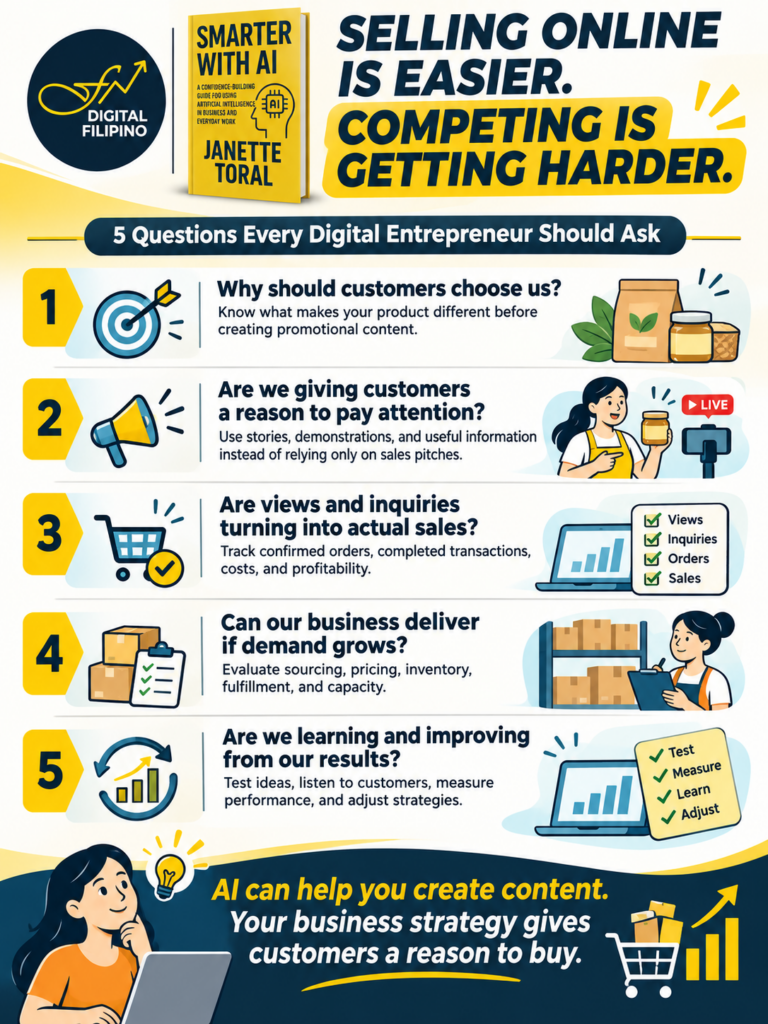
Before creating content, understand what makes the product different
In our recent E-TAAS ang Pinay workshop, we began with brand positioning before proceeding to social media campaigns, website mockups, and live-selling scripts. This sequence was intentional.
Entrepreneurs often approach digital marketing by asking what they should post, which platform they should use, or how AI can help them produce promotional materials. But before answering those questions, they need to understand what makes their products worth choosing.
If several businesses sell similar food products, clothing, or household items, why would a customer buy from one rather than another? Is it the quality, ingredients, craftsmanship, convenience, reliability, price, or the experience associated with the product? These distinctions influence the stories entrepreneurs tell and the promises they make to customers.
AI can help explore possible positioning statements, campaign concepts, and customer messages. However, entrepreneurs must evaluate whether those ideas accurately represent their products and appeal to the people they want to serve.
A beautifully designed advertisement cannot compensate for an unclear offer. This is why digital marketing should begin with understanding the business and its customers rather than immediately producing content.
Moving beyond the usual sales pitch
One challenge I frequently observe is the tendency to create promotional messages that simply announce a product, state its price, and encourage people to buy. There is nothing inherently wrong with direct selling. Customers sometimes know exactly what they want and appreciate straightforward information.
But when many sellers are competing for attention, repetitive promotional messages may struggle to generate interest. Entrepreneurs need to consider how they can help customers understand or experience their products.
A food entrepreneur might demonstrate how a product is prepared, explain what makes its ingredients distinctive, or show different ways customers can enjoy it.
A clothing seller might demonstrate how an item fits, discuss the fabric, or show how it can be worn for different occasions.
A business offering household products might address common customer questions through demonstrations rather than relying entirely on product descriptions.
These approaches provide customers with information they can use when deciding whether to purchase.
During our workshop, storytelling and live-selling exercises encouraged participants to think beyond what they wanted to say about their products. They also needed to consider what customers would find interesting, useful, or convincing.
The TikTok live-selling experience illustrated this challenge. Singing and dancing created a lively moment, but entertainment is only one possible approach. Other sellers may be more effective through demonstrations, informative conversations, or a relatable personal story.
What works depends on the product, the audience, and the seller’s ability to connect with potential customers. The objective is to create meaningful interest that can lead to actual business.
Attention is valuable, but conversion is what sustains a business
Social media platforms provide many indicators of audience activity. Entrepreneurs can monitor views, reactions, comments, shares, inquiries, and orders. These metrics can help them understand how customers respond to their campaigns. However, they represent different stages of the purchasing process.
A video may attract thousands of views without generating inquiries. A livestream may receive many comments but few orders. Even when customers indicate that they want to purchase, transactions may remain incomplete. For entrepreneurs, this means looking beyond the excitement of online engagement.
How many inquiries become confirmed orders? How many orders are paid for and fulfilled? Which products attract repeat customers? How much does the business spend to generate each sale? After accounting for product costs, packaging, delivery, platform charges, and promotional expenses, how much profit remains? These questions are particularly important for MSMEs operating with limited marketing budgets.
AI may reduce the time and effort needed to create content, but it does not automatically improve conversion rates or profitability. Entrepreneurs still need to understand customer behavior, respond to concerns, monitor performance, and adjust their strategies.
The ability to interpret results is becoming just as important as the ability to produce marketing materials.
Thinking beyond hundreds of orders
Another discussion I often introduce during training is the possibility of selling thousands of units rather than hundreds. The intention is to encourage entrepreneurs to think about the scale of their opportunities and the business decisions required to pursue them.
What would happen if demand suddenly increased? Could suppliers provide sufficient materials? Would production costs decrease at higher volumes? Could the business maintain quality and deliver orders on time? Would the entrepreneur need additional working capital, equipment, personnel, or distribution partners? These questions help connect digital marketing ambitions with operational and financial realities.
Not every entrepreneur needs to pursue a high-volume strategy. Some products are better suited to specialized markets, customized orders, or premium positioning. What is important is understanding which approach makes the business competitive and financially sustainable.
Filipino entrepreneurs are also operating in marketplaces where customers can easily compare local products with those offered by international sellers, including businesses benefiting from large-scale manufacturing and distribution.
Consumers make decisions based on their needs, preferences, and budgets. Supporting local businesses is valuable, but entrepreneurs cannot assume that customers will choose their products solely because they are locally made. They need to offer compelling reasons to buy.
For some businesses, this may involve competitive pricing and efficient sourcing. For others, the advantage may come from distinctive designs, product quality, customization, customer service, or a stronger connection with a particular market.
Digital marketing helps communicate those advantages. The business must be capable of delivering them.
What happens after the workshop?
The E-TAAS ang Pinay program has been implemented in different locations and formats. While originally designed as a three-day program, some implementations are conducted over two days because of budget limitations. Others use webinar formats rather than face-to-face sessions.
These arrangements require trainers to make choices about what participants can realistically learn and practice within the available time.
In my experience, practical exercises help entrepreneurs see how different activities connect. Brand positioning informs campaign development. Campaign concepts influence website content and live-selling scripts. Customer interactions provide information that can be used to improve future promotions.
But completing these exercises during a workshop is only a beginning. In earlier digital entrepreneurship programs, I used 21-day marketing campaigns to encourage participants to apply what they learned and report their results. Some generated sales, while others discovered what needed improvement.
Those experiences reinforced an important lesson: Training can introduce ideas and create opportunities to practice, but sustained improvement depends on what entrepreneurs continue doing afterward.
A business may need to revise its positioning, experiment with different messages, improve product photography, review its pricing, or change the platforms it uses. Sometimes the right decision is to continue a campaign. At other times, the results may suggest changing direction.
Consistent practice should therefore involve learning and adjustment, rather than repeating activities simply for the sake of remaining active online. This is also worth considering for organizations that invest in entrepreneurship development. Beyond teaching new tools, there is value in helping participants build the confidence and judgment to evaluate their own strategies as market conditions change.
Competing in an increasingly accessible digital economy
Three years of facilitating E-TAAS ang Pinay have reinforced how quickly digital selling continues to evolve.
Entrepreneurs now have access to technologies that would have required significantly more time, resources, or technical expertise in earlier years. AI can support brainstorming, content development, and business analysis. Social commerce creates new ways to demonstrate products and interact directly with customers.
These developments offer genuine opportunities, especially for smaller businesses. At the same time, easier access to technology means that using digital tools is becoming less of a competitive advantage on its own.
What distinguishes businesses increasingly depends on how well they understand their customers, communicate their value, manage their operations, and respond to changing market conditions.
For entrepreneurs, the challenge is to move beyond simply becoming visible online toward building businesses that customers are willing to choose and return to.
For trainers and entrepreneurship development organizations, the opportunity is to connect digital skills with practical business decisions and encourage continued learning beyond the classroom.
Selling online may be easier than ever. But becoming a business that customers consistently choose, and that can serve them profitably, requires much more than access to the latest tools.

Leave a Reply